Showing posts with label choices. Show all posts

Wednesday, November 16, 2011

How Do We Manage to Survive in This Complex World?

As soon as we are born we start to experience life and we start to "survive". Our senses are filled with whatever surrounds us. These experiences are pleasant or unpleasant. By nature we are the kind of creatures who don't like to suffer, so we are constantly looking for pleasant experiences and trying to avoid unpleasant experiences. To be able to do that we carefully observe our environment.

There are certain things we can already observe in our environment from a very young age. To simplify things here I just talk about people and objects.

There are millions of people and objects surround us. We can notice that some of them are almost permanent or just slowly change. Think about your family or your neighborhood. Some of them constantly change. Think about what you see on television or passengers on a train. By recognizing this we learn to trust in those things which are more permanent. This gives a sense of security in "space".

Another thing we learn that we can "predict" the future to a certain level. This is because things don't change, at least most of the time suddenly. This gives a sense of security in time. If our environment would constantly and rapidly change that would be unbearable.

We also notice that there are many similar objects we don't have to learn about each individual person or object which belongs to a group. Think about a nation, or cars.

It also helps that we learn to imitate others around us. That's how we learn how to use a spoon. Sometimes we don't even know why we do things, we just follow others.

Since pleasant experiences give happiness and satisfaction we use our knowledge to get more of these experiences. We learn early that they don't come easy, it takes certain effort to get satisfied. Think about when you go to the gym or when you finish a project. At a very early age we also find out that there is always help you just have to learn how to ask for it. Think about a crying baby or visiting your doctor.

Saturday, November 12, 2011

You Don't Have to Be Optimistic All the Time


In our society everything seems to make us believe that we have to be optimistic and happy all the time. Pessimistic people often pictured as losers. They expect from us to smile no matter what and to say that everything will be just fine. They make us believe that we are either born optimistic or pessimistic.

The one-size-fits-all optimism doesn't really work and can be harmful sometimes. Optimism and pessimism are feelings about the future. Both optimism and pessimism act like energizers in certain situations. If we were only realistic about our future we wouldn't even try to do things saying "it's just impossible".

Optimism and pessimism can also be a mind-set to adopt certain situations. In some situations it's better to be optimistic in others better to be pessimistic. Optimism can help us not to give up and cope with difficulties. Pessimism can help us to prepare ourselves if we won't succeed. Pessimism can help to better protect ourselves. This is also called defensive pessimism.

Of course in many situations it's much better to be optimistic. Some examples are when you are looking for a job, start to date, want to lose weight or start a business. Optimism can work against you when you gamble, when you are an investor, when you think that you can always get what you want.

Pessimism can be of course a negative feeling too. When you think that you will never get a job, never find a boy or girlfriend or never will be able to lose weight. Pessimism is bad when it makes you sort of give up.

Pessimism is good when it protects you, when it prepares you to the "what if" situation. Whit a pessimistic mind-set you will able to handle stress better. Pessimism is good when you don't over-expand because you are not 100% sure about your job and/or income or as an investor you diversify. Pessimism is also somewhat good when you or someone close to you have an illness. It helps you to prepare yourself to the worse scenario.

Saturday, October 29, 2011

Is Risk-Taking Good or Bad?

Taking risks has been part of our daily life since the early evolutionary times. Back than without risk there was no survival or reproduction. Risk-taking lead mankind to our sophisticated society we live now. These days behind risk taking besides survival and reproduction there is money, love and power.

Risk-taking is a very positive behavior if it's used properly. Without risk life would be very boring, everything would be predictable. When we talk about risk we always imply that there is a possibility of danger, tension and loss.

Each risk has two sides, an upside and downside. If the downside is much higher than the upside the risk is considered a "stupid" risk. Why would you spend your paycheck on lottery tickets? You could lose everything and win nothing.

Calculated risk or intelligent risk is when the downside or loss is limited and the reward far outweighs the downside. When you apply for a job there is risk, you might be rejected but on the upside you could land in a great carrier. When you try to date someone you could also be rejected but you could also find some who will be with you for the rest of your life. When you start a business there is risk, with unlimited potentials on the upside.

People, businesses, governments take risks all the time. We do things all the time where we are not sure about the outcome. Risk with a limited downside is always welcome but unlimited downside or "gambling" can turn against us. 

Thursday, October 21, 2010

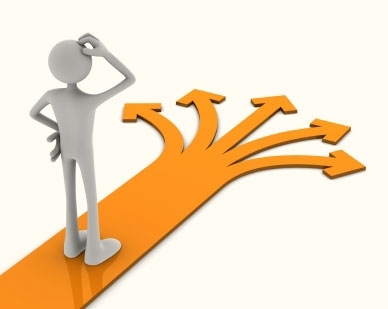
How to Make Smart Decisions


We are making hundreds of decisions every day but most of them are small decisions. Making decisions is almost always fun and gives a sense of freedom. Decisions which later on turn out to be good also boost our self-confidence. Making decisions means that we are not doing the same thing over and over again.

Small decisions are what to wear, what to eat, which movie to see, which book to read, what to do on the weekend, which shoes to buy and many more. When we regret our small decision later, it's not a big deal, we forget about it quickly.

There are also major decisions. These don't happen often but the consequences may last for a long time sometimes for a lifetime. Examples of major decisions are who to marry, what to do for a living, where to live, which house to buy, which car to buy, where to go for a vacation, how many children to have and more.

Before you make your decision you want to make sure that you know enough information about what you will make the decision. Don't get too excited and let just one or two things influence you. Don't make a decision in a hurry unless it's about calling 911. Sleep on it, there is always another opportunity. Make a list of all the pros and cons. You can only make this list if you are well educated about the subject of your decision. Go with the longer list to make the smartest decision. The more good decisions you make the easier will be to make good decisions in the future even in difficult situations.